
D-I-Do or D-I-Why?
A few simple lessons in DIY home repair

At long last, after decades of saving money for a down payment, you’ve finally purchased your first home. Sure, it’s a fixer-upper, but oh, what a deal!
The elation that home-ownership brings has instilled you with a hubris that views your new dwelling as having “loads of potential,” just like the real estate agent said.
With that in mind, it should be easy to improve the joint to increase your property’s value. It’ll only take a few simple “sweat equity” projects. After all, you consider yourself a handy fellow. Having once helped your Dad build a small garage 30 years ago, you consider that more than enough experience to be qualified as a competent contractor. And wherever your building knowledge falls short, there’s always help from YouTube and the internet!

The first project you attempt is the “She-shed.” This task became a priority due to the cold-eyed stare from your wife, who inexplicably needs a special place to store her gardening tools. Although why anyone needs a full 10 ft by 10 ft shed to store a small hand rake and trowel is a true mystery and a reason for debate.
Being that you would like to avoid such a lengthy argument and weeks of scornful belittlement, you mollify the wife and acquiesce to her demand.
The next several weeks are spent planning, buying materials, and constructing the mandated “She-shed.”
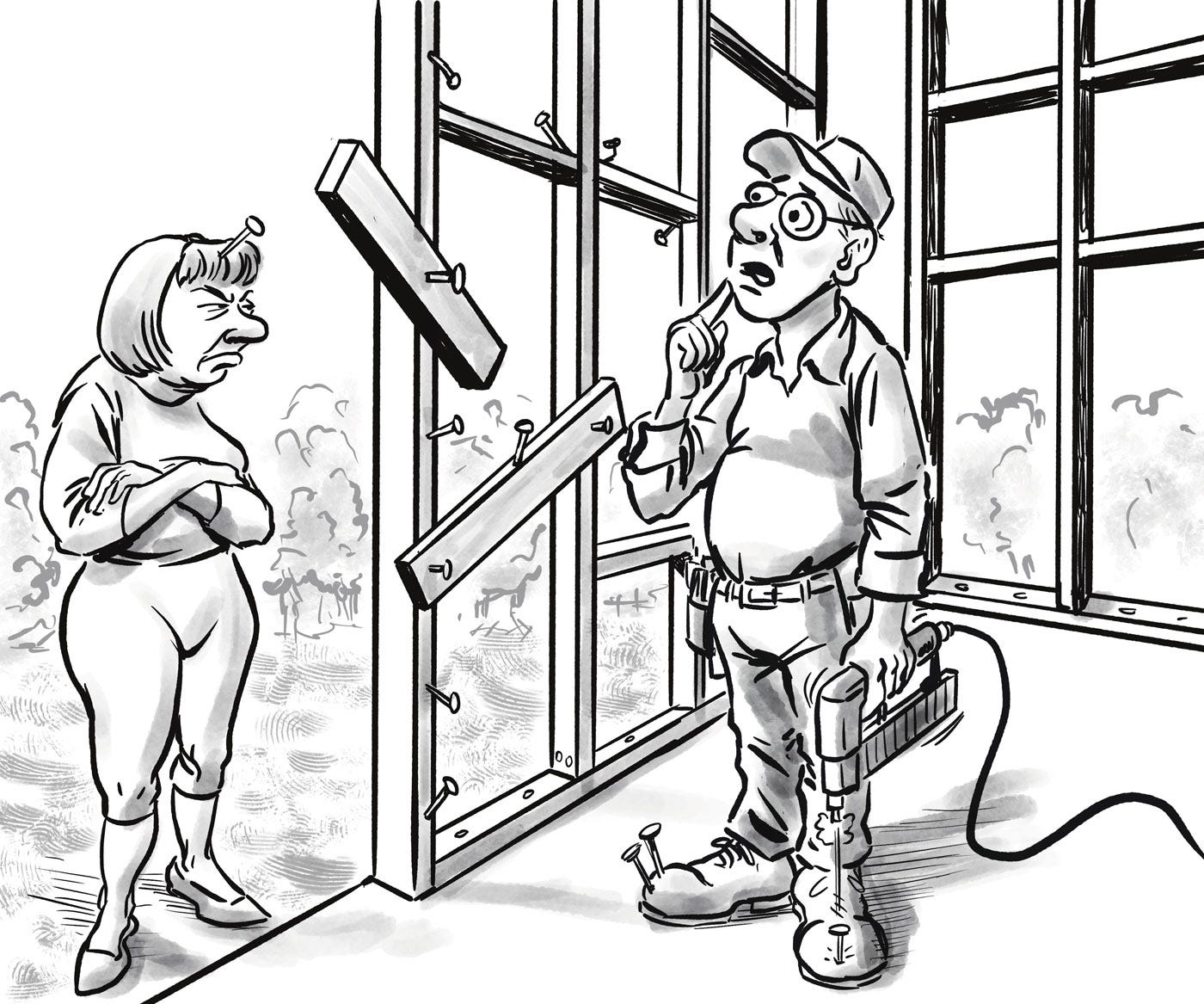
However, upon completion, your wife informs you that the door needs to go on the opposite side of the shed; all the shelves need to be raised a foot; the roof needs a better slant for drainage; and there are no windows with southern exposure. WHERE’S THE SOUTHERN EXPOSURE!!!
Afterwards, your wife orders the shed she wants from Amazon.
You then tear down your shed and toss the wood planks into a corner of the garage. You knowingly lie to yourself in thinking all that wood will be useful in some future project.
Now that you’ve gotten through that debacle with your wife, it’s time to begin the real work on the house.
You’ve noticed the home lacks any proper moisture venting in the bathroom. Installing simple bathroom fan would solve this. As part of this install, you’ll have to create hole in the roof for a vent.
“No problemo.” you tell yourself, “Any idiot can put in one of those!”
You climb up on the roof with your trusty drill, the one you bought at the discount tool and hardware shop down the street. On it you’ve attached a cheap 5 inch hole saw drill bit you’ve purchased from Amazon. The drill bit is a bit too big for your drill, but you’re sure some extra-tightening on the chuck of the drill will hold it.
You fire up the drill and press it down to the roof.
The drill bit goes flying off the drill and narrowly misses severing your leg.
You walk across the roof to collect the hole saw drill bit. On the walk over to the saw, you feel several soft spots in the roof. This concerns you but you disregard them since your focus is on drilling out that hole for a vent.
You pick up the drill bit, re-tighten it down on the drill, and then, ever so carefully, step back to where the vent will go.
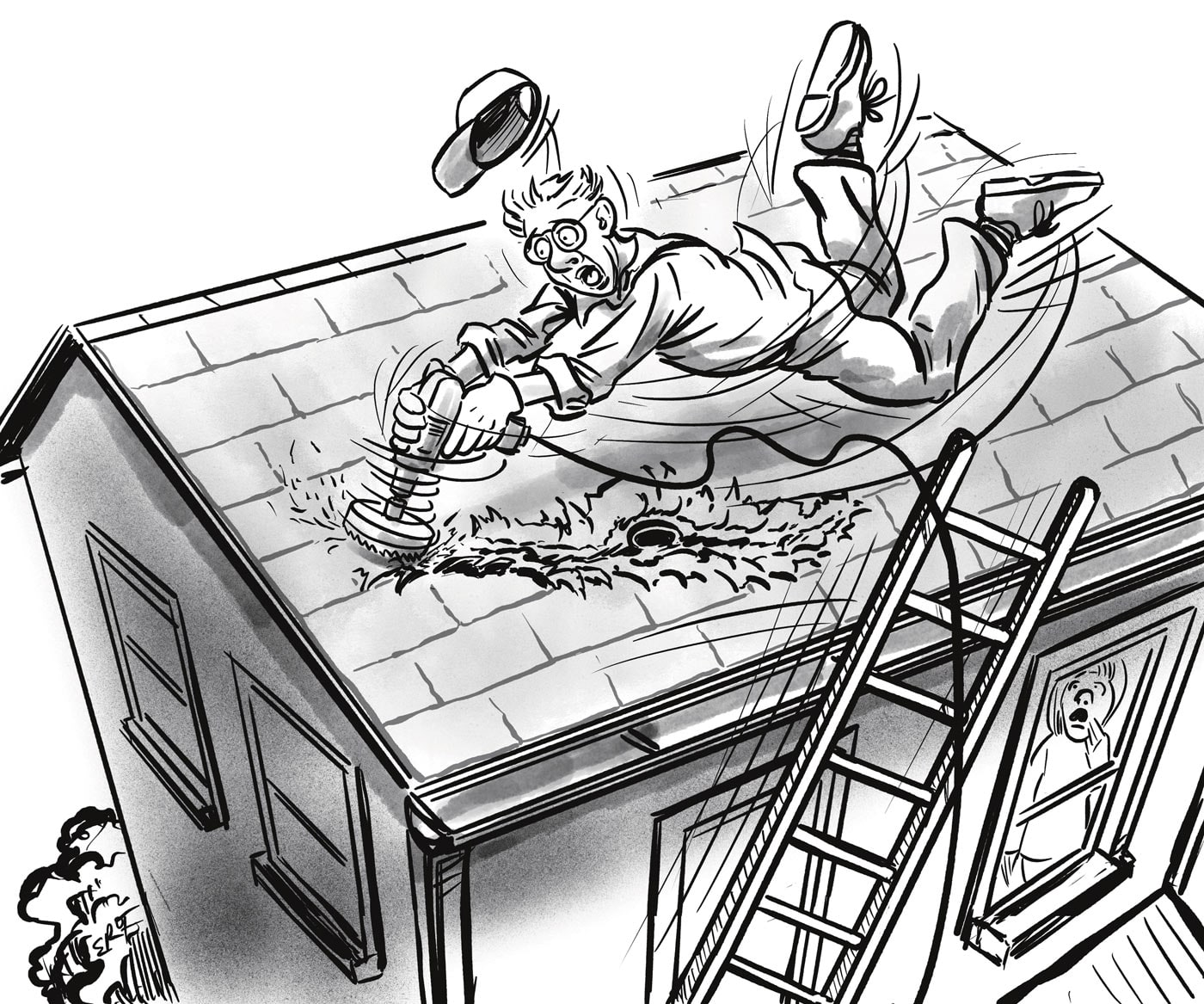
This time, when you fire up the drill and press it to the roof, both the drill AND YOU go skidding across the roof as the hole saw tears a 12-foot gash into the wood and roofing!
Congratulations, you’ve learned your first lesson in DIY home repair.
No matter how cheap your repair budget is, always tack on a few thousand to hire a qualified contractor who’ll fix what you screw up.
When you looked at the house, your realtor said everything in this house was “mid-century modern.” Over time you realize that she failed to specify which century.
This had made you focus on a light fixture hanging from the kitchen ceiling. It looks to be from the turn of the century, two centuries ago. It mocks you from on high with its blinking bulb and nasty habit of sparking when the toaster is plugged in.
This motivates you to decide to delve into DIY electrical repair to replace that ugly old luminaire.
To begin the project, you rush out and buy an expensive, fancy-schmancy new ceiling light to install. You also satisfy your inner DIY wannabe electrician with buying a step ladder, basic electrical wire strippers, a small non-contact voltage tester, and a few rolls of electrical tape. Wheeee!
When you get home, you set up the ladder in the kitchen, climb up to the light, and begin to remove it.
The old light sends out a spiteful spark in your direction before you touch the base of the light. This causes you to fall from the ladder.
It also reminds you that maybe you should first shut off the circuit breaker to the light. As you walk over to the breaker box, you wave a fist at and taunt the old lamp for its failed attempt at electrocuting you.
Once the power is shut off, up the ladder you go to remove the base of the light. Once the base is off, you discover there are three extra unconnected wires, curled up in the receptacle like vipers ready to strike. You take out your voltage tester and touch the wires.
Dammit! Two of the wires are still live!
This means you need to turn off the main circuit breaker and then have a look up in the attic to test what wires are connected to this light.
Main breaker off, you move the step ladder to the attic hatch and crawl up to investigate.
Since the power is off, you use a tiny flashlight to illuminate the dark attic. However, because you forgot to put new batteries in it, the flashlight is barely bright enough to see more than a flicker into the darkness.
Fumbling around up there, your hands can feel wires, lots of wires. Too many wires. Some of the wires that feel like snake skin.
The flickering flashlight manages to barely reveal a large junction box a few feet in front of you. It resembles the head of Medusa. Dozens of wires slither out of it and twist across the attic floor and under the blown insulation.
You mumble,“What lunatic wired this place?”
You decide to get closer look into the junction box. Taking out your screwdriver, you open the box to see if there’s another shut-off switch in this mess.
At the exact moment that you’re fiddling around with your screwdriver amongst the wires, your wife arrives home from the store.
She notices the power is off and assumes the main breaker must have tripped.
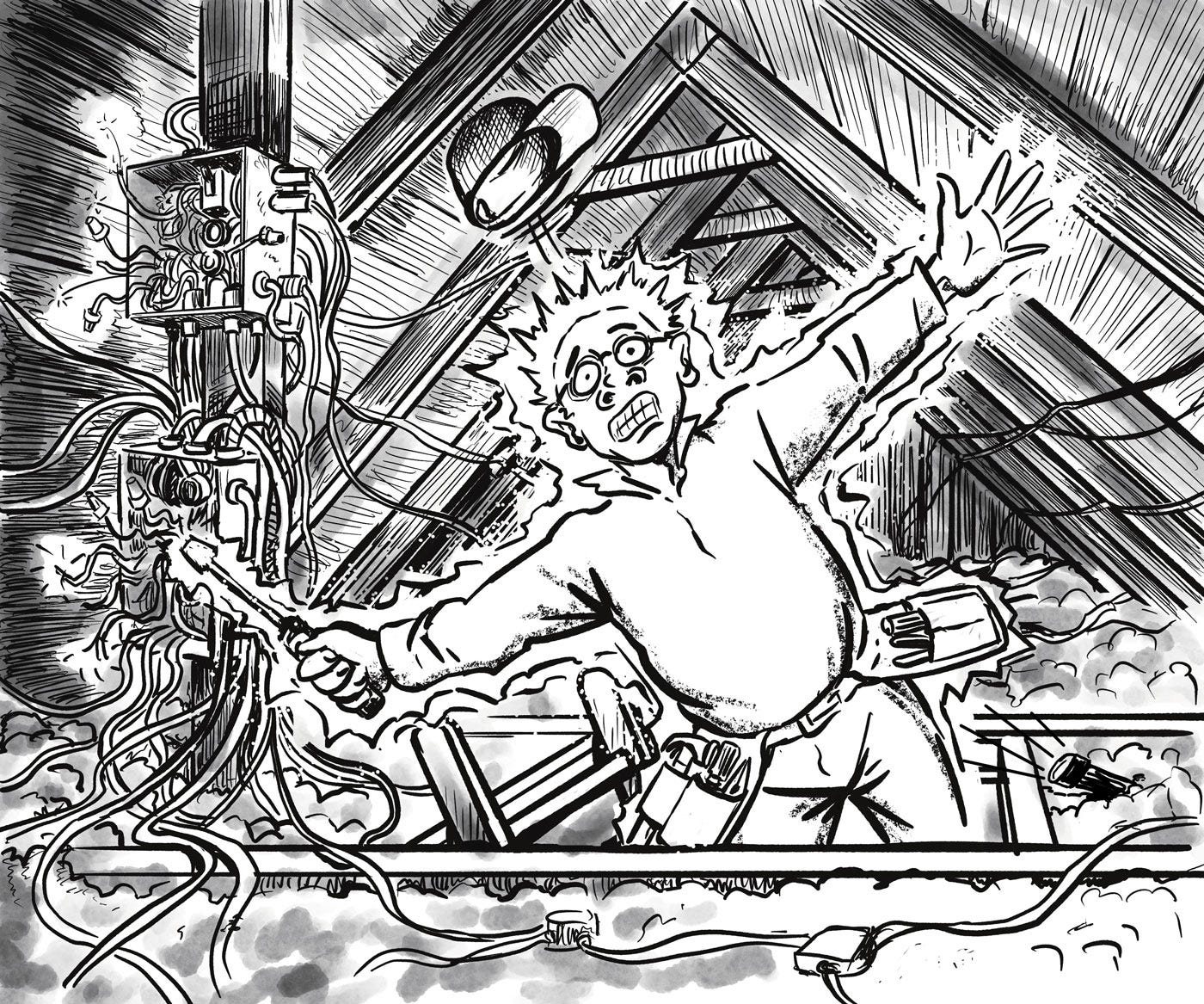
As She flips the breaker back on, she hears a stuttering screech emanate from the attic.
You’ve now learned the second lesson in DIY home repair.
Any fixer-upper you buy has been wired, de-wired and rewired by a series of equally idiotic DIY wannabe electricians.
After living in your fixer-upper home for a few years, you’ve come to realize that whoever originally built this place was a cunning villain. Based on the number of times each attempted home repair ended in a trip to the ER, you’re convinced that this isn’t actually a house at all. It’s actually a meticulously designed death trap, possibly one that inspired the “Saw” movie franchise.
There isn’t one spot in this house where, if you hang a picture on one wall, another wall drops its plaster; if you plug in a TV in one room, the oven stops working; or if someone rings the doorbell, all the faucets in the bathroom spray boiling hot water.
Truly the work of an evil genius, or more likely, a collection of accidental evil geniuses!
You glumly accept that every aspect of this dwelling is the culmination of foolish, pricey mistakes made by a long line of previous DIYers, and that you’re the latest sucker trapped in this “mid-century modern” abattoir .
Oh, but what a deal!

Now that you’ve succumbed to the reality of DIY home ownership, you might be tempted to run a tally on all the money you’ve poured into repairs on the place.
Don’t do it!
Studies have shown that most DIY homeowners fall into a state of dangerous psychosis upon learning, that for the amount of money they’ve spent on repairs, they could have bought a brand new, PROBLEM-FREE home!

This brings us to the final lesson in DIY home repair:
“Sweat Equity” is a load of bullshit!
I hope you enjoyed my little post. Any similarity to any person other than my own imbecilic DIY self is purely coincedence. Cheers!
100% on all of it. We bought a 1950 house from a flipper in the mid 90s, and we’ve been finding his bullshit repairs and shortcuts for 30 years.
That Burns Me Up. P.S. Andy Graziano says hello!